

VAT registration for Saudi businesses: thresholds and invoices
Mandatory registration generally starts above SAR 375,000; voluntary eligibility starts at SAR 187,500, subject to conditions. Learn what changes on invoices.
VAT registration for businesses depends on the value of supplies and the business's circumstances, rather than simply holding a commercial registration. For a resident business, registration is mandatory when supplies counted for registration exceed SAR 375,000 over the preceding twelve months, or are expected to exceed that amount over the following twelve months, subject to statutory exceptions. A person who is not required to register may register voluntarily if qualifying supplies or expenses reach SAR 187,500 or more over the preceding twelve months, or are expected to reach that threshold over the following twelve months. Before changing your invoices, distinguish the registration decision from its effective date. Guideline, 3.2 and 3.3; Regulations, Articles 3, 4 and 7.
What is the difference between mandatory and voluntary registration?
Start with this table, bearing in mind that the comparison concerns resident businesses:
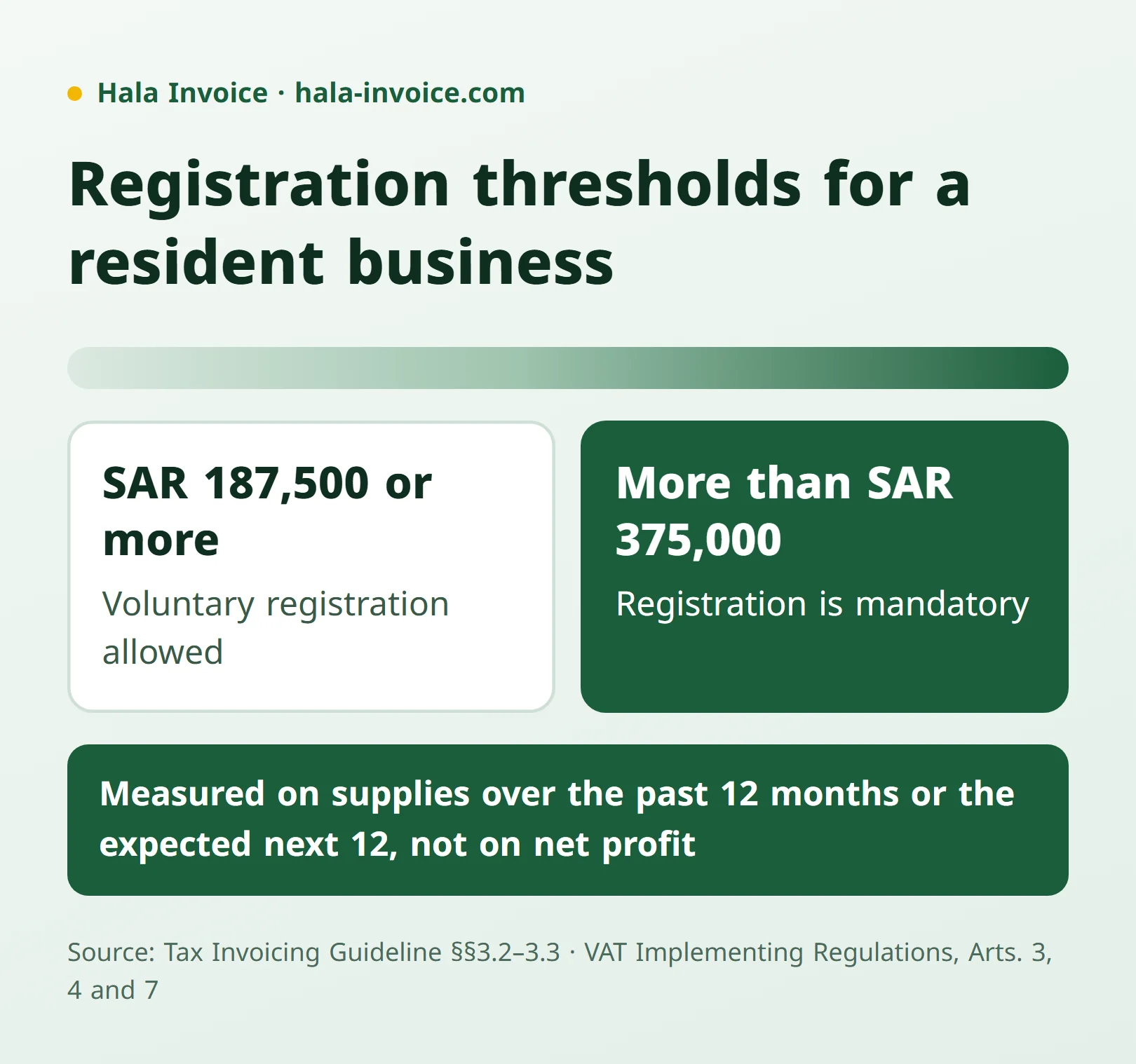
| Situation | Financial threshold | General result |
|---|---|---|
| Past or expected supplies exceed the mandatory threshold | More than SAR 375,000 | Registration is required unless a statutory exception applies |
| Voluntary registration conditions are met without mandatory registration being required | Supplies or expenses of SAR 187,500 or more | A voluntary registration application may be made |
The amounts come from the Guideline, 3.2 and 3.3; the two measurement periods and inclusion of the exact voluntary threshold come from Articles 3, 4 and 7 of the Regulations.
Where all supplies are exclusively zero-rated, an exception to mandatory registration exists, while voluntary registration remains possible. A nonresident obligated to pay VAT in the Kingdom is subject to a separate rule, so do not automatically apply the resident-business threshold table to that person. Regulations, 9(1), and Article 5.
How do you calculate the amount to compare with the threshold?
The mandatory registration test measures supplies, rather than net profit. An unregistered resident business reviews actual and estimated supplies at the end of each month, using a rolling twelve-month period; waiting until the financial year ends is therefore insufficient. Regulations, 3(1) and 4(1).
Exempt and out-of-scope supplies are excluded from the taxable-supplies calculation described in the guideline. Qualifying capital-asset disposals are excluded subject to their conditions, including use in the business and the asset not being held to generate rental income or for later supply. Guideline, 3.2; Regulations, 6(5).
For a practical review, we suggest preparing a schedule showing each transaction's type, value and period, with a separate field explaining any exclusion. Discuss unclear classifications with your accountant before calculating the total, and keep documents supporting sales forecasts rather than using an optimistic estimate without a basis.
When do you apply, and when does registration take effect?
When either the actual or expected threshold test is met, apply within thirty days of the end of the relevant month. Under the actual-supplies test, registration generally takes effect at the start of the month following the application month. Under the expected-supplies test, it takes effect at the start of the first month in which annual supplies are expected to exceed the threshold. Regulations, Articles 3 and 4.
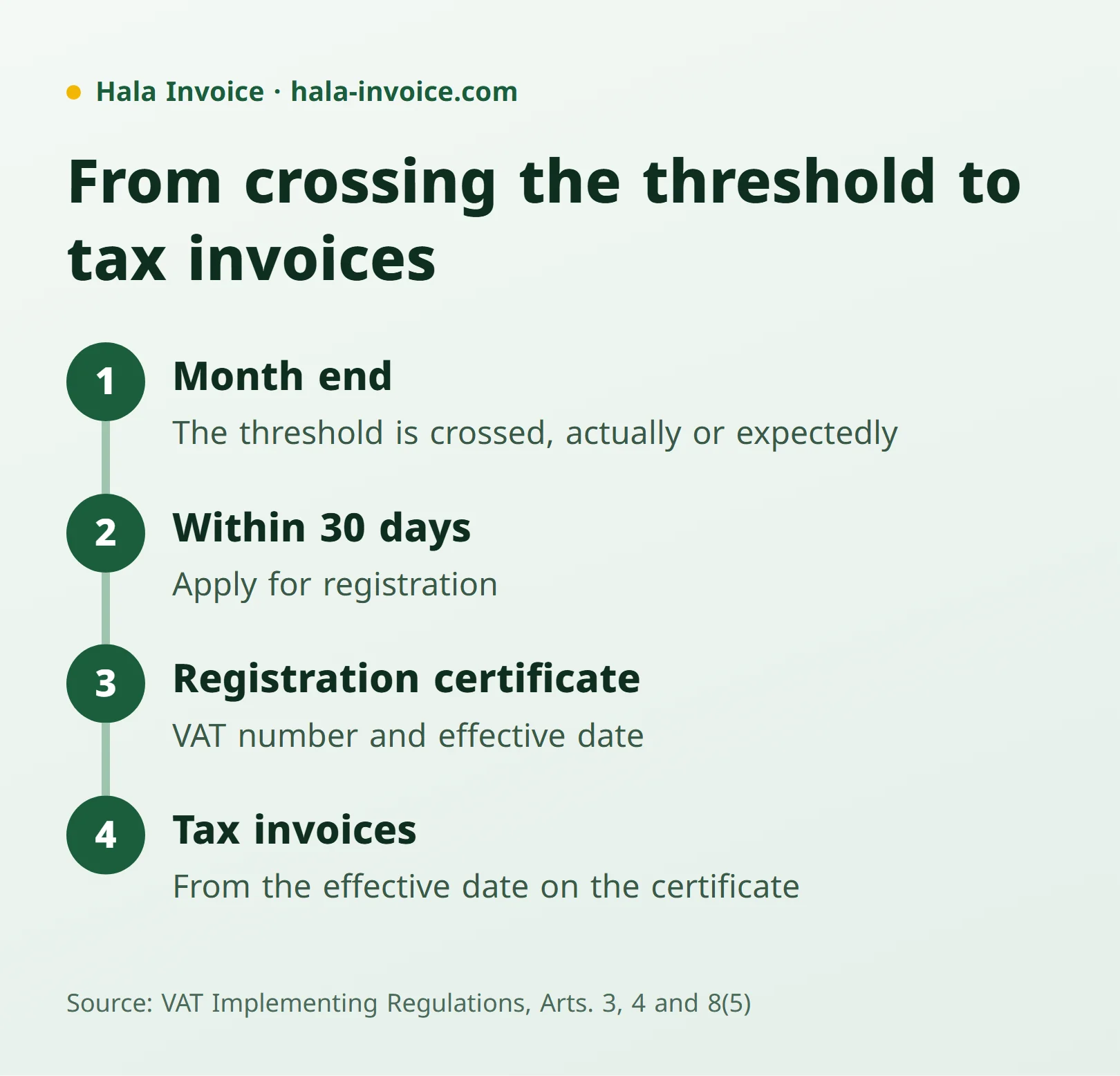
To organize the transition, follow these steps:
- Review your schedule of actual supplies and forecasts, and identify the registration basis that applies.
- Prepare the business details, identification numbers and activity documents, and review them with the person responsible for accounts.
- Once the application is accepted, read the registration certificate: it contains the tax identification number and effective date. Regulations, 8(5).
- Give the certificate details to the person responsible for invoicing and ask them to review a sample before using it with customers.
Do not assume that applying late postpones the obligation. The authority can register someone who failed to apply, using the effective date prescribed by the relevant provisions. Regulations, 6(1).
What changes on your invoices after registration?
You need to use your registration number on the tax invoice and show supplier, supply and monetary details according to its type. Apply 15% when the transaction is subject to the standard rate, rather than simply because the business is registered. Tax invoices must also be issued in Arabic; another language may be added. Guideline, 1.3, 4.2.1, 4.2.3 and 4.3.2.
See how to issue a Saudi tax invoice to identify the right document and calculating VAT to review the figures. Preparation also includes keeping invoices, records and accounting documents relevant to VAT calculations; see the invoice retention guide for more detail. Guideline, 8.1 and 8.2.
Common mistakes before moving to tax invoices
- Comparing the threshold with net profit instead of the supplies specified by the registration rules.
- Reviewing past sales while overlooking expected supplies.
- Treating voluntary registration as having no subsequent obligations because the business chose to register.
- Starting to collect VAT before establishing registration status and its effective date, or copying another business's number.
This review follows Articles 3, 4, 7 and 8 of the Regulations, the restriction on unregistered persons issuing tax invoices, and the supplier-number requirement in the Guideline, 4.1.3 and 4.2.3.
Practical rule: review the registration threshold monthly, then set invoice details according to the registration status and effective date recorded on the certificate.
After reviewing your registration details, start preparing your invoice with Hala Invoice's free invoice generator.
Frequently Asked Questions
What is the VAT registration threshold for Saudi businesses?
The general mandatory threshold for a resident business is supplies counted for registration exceeding SAR 375,000, considering both the preceding and following twelve months. Guideline, 3.2; Regulations, Articles 3 and 4.
Can I register if my sales are exactly SAR 187500?
The provision includes the threshold amount itself: Article 7 uses “not less than” the voluntary threshold, subject to the other registration conditions. Regulations, 7(1).
Is VAT registration based on profit or sales?
The mandatory test uses the value of supplies calculated under the registration rules, rather than net profit. Regulations, 3(1) and 4(1).
When should I start putting my VAT number on invoices?
Check the effective date on your certificate, then apply the tax-invoice requirements to the relevant transactions; the supplier's number is a required detail. Regulations, 8(5); Guideline, 4.2.3.
Keep learning
Related Saudi guides
Invoice Types
How to issue a tax invoice in Saudi Arabia
Choose a standard or simplified invoice, enter the required details, calculate VAT, and check the issue date and QR code using official ZATCA sources.
Read guideInvoice Types
Quotation invoice: when do you need a tax invoice instead?
A quotation sets out a commercial proposal. Learn what to include and when a sale or advance payment requires a tax invoice instead.
Read guideInvoice Types
Receipt voucher or tax invoice: when do you need each?
A receipt voucher records money received but does not remove a required tax invoice. Learn the difference, advance-payment rules, and how to link the documents.
Read guideReady to Create Your Invoice?
Create a local invoice PDF with ZATCA-format QR data – free with no signup
Create Invoice Now✓ 100% Free • ✓ No Signup • ✓ ZATCA-format QR data