
Quotation invoice: when do you need a tax invoice instead?
A quotation sets out a commercial proposal. Learn what to include and when a sale or advance payment requires a tax invoice instead.
If you are looking for a quotation invoice to show a customer your proposed price, and you mean a quotation for negotiation before a supply, do not treat it as the required tax invoice: a tax invoice concerns a taxable supply and contains its legally required information. ZATCA's electronic-contracts guide describes an example beginning with a quotation, followed by negotiation and execution of a contract; the example does not cover invoicing, which follows its own rules. Identify the document's purpose before choosing its heading and content. Source: invoicing guideline, section 2, and electronic-contracts guideline, section 6.5.1.
What is the difference between a quotation and a tax invoice?
Use this distinction to organize your dealings with the customer, while treating the tax-invoice requirements as the reference when an invoice becomes due:
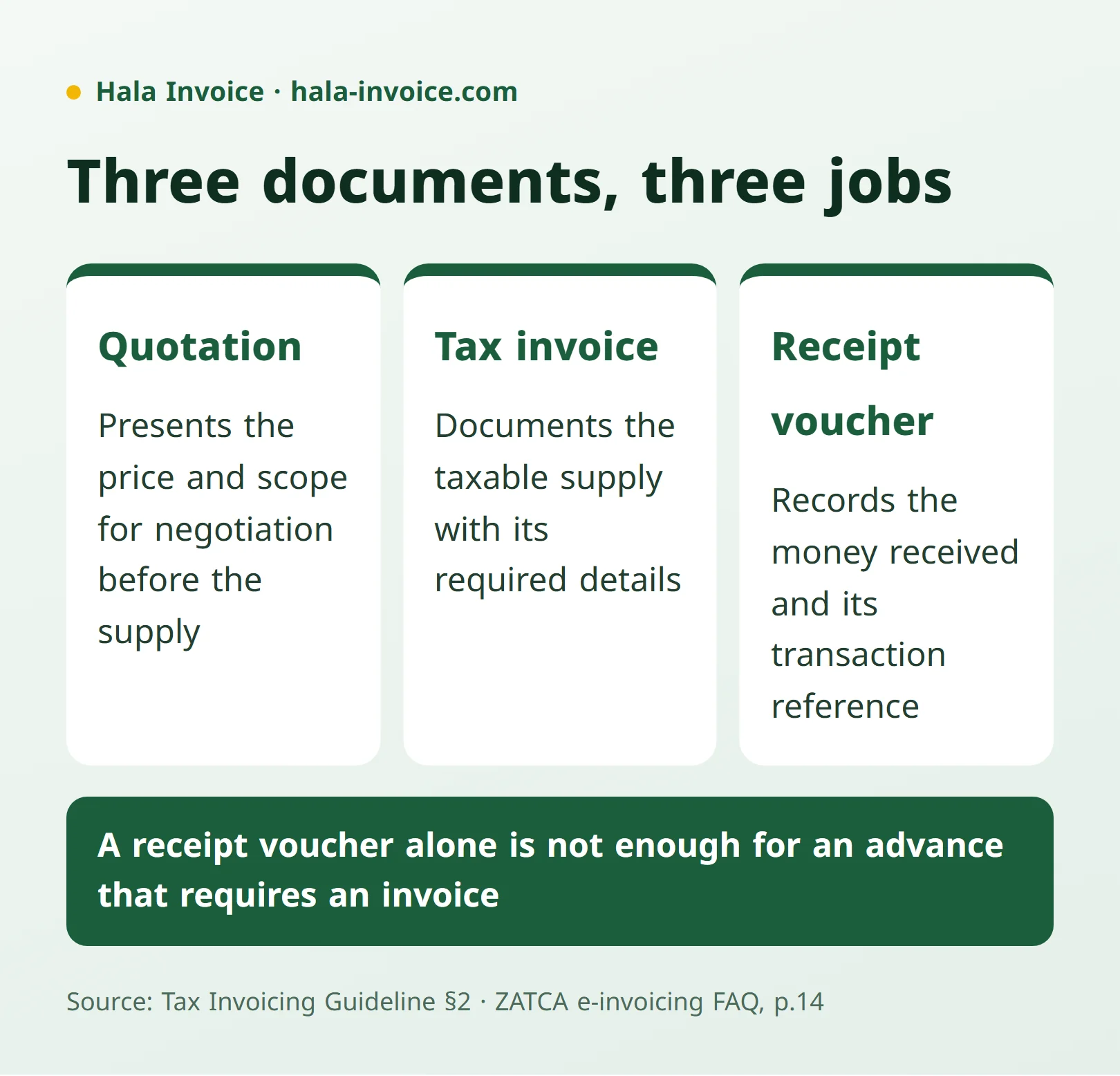
| Document | Purpose in the suggested workflow | What should you review? |
|---|---|---|
| Quotation | Present the price and scope for negotiation | The items, quantities, and terms you propose |
| Tax invoice | Document the taxable supply with the required information | Supplier, transaction, tax information, and invoice type |
| Receipt voucher | Record the money you received | The payment and its related transaction reference |
The tax distinction does not depend on design alone. ZATCA's guide links tax-invoice status to taxable supplies and the requirements of Article 53 of the Implementing Regulations. Specifically for advance payments, ZATCA confirms that a receipt voucher alone is insufficient in place of an electronic invoice. Source: invoicing guideline, section 2, and e-invoicing FAQ, p14.
What should you put in a quotation?
The following is an editorial recommendation for organizing your quotation, rather than a list of quotation fields mandated by tax-invoice rules:
- Use the heading “Quotation,” followed by your business name, contact details, and the customer's name.
- Add a quotation reference and preparation date so you can distinguish its versions.
- Describe each product or service, specifying the quantity or scope and what the price includes.
- Show unit prices, discounts, and the total, and clarify how VAT is presented when your business is registered and VAT applies to the transaction.
- State the commercially chosen price-validity period and proposed payment and delivery terms.
- Add a method for the customer to confirm the quotation, and retain a copy of the agreed terms.
Do not present all these commercial choices as tax-invoice requirements. ZATCA's guide itself classifies payment due dates, contact details, and shipping information as commercial additions. If you are unregistered, read the guide to invoices without a VAT number before including an amount described as VAT. Source: invoicing guideline, section 4.2.5, and section 4.1.3.
When must you issue the tax invoice?
Do not use the quotation's expiry date or the date you request payment as your deciding test. ZATCA's guide sets issuance deadlines according to the invoice type and tax event:
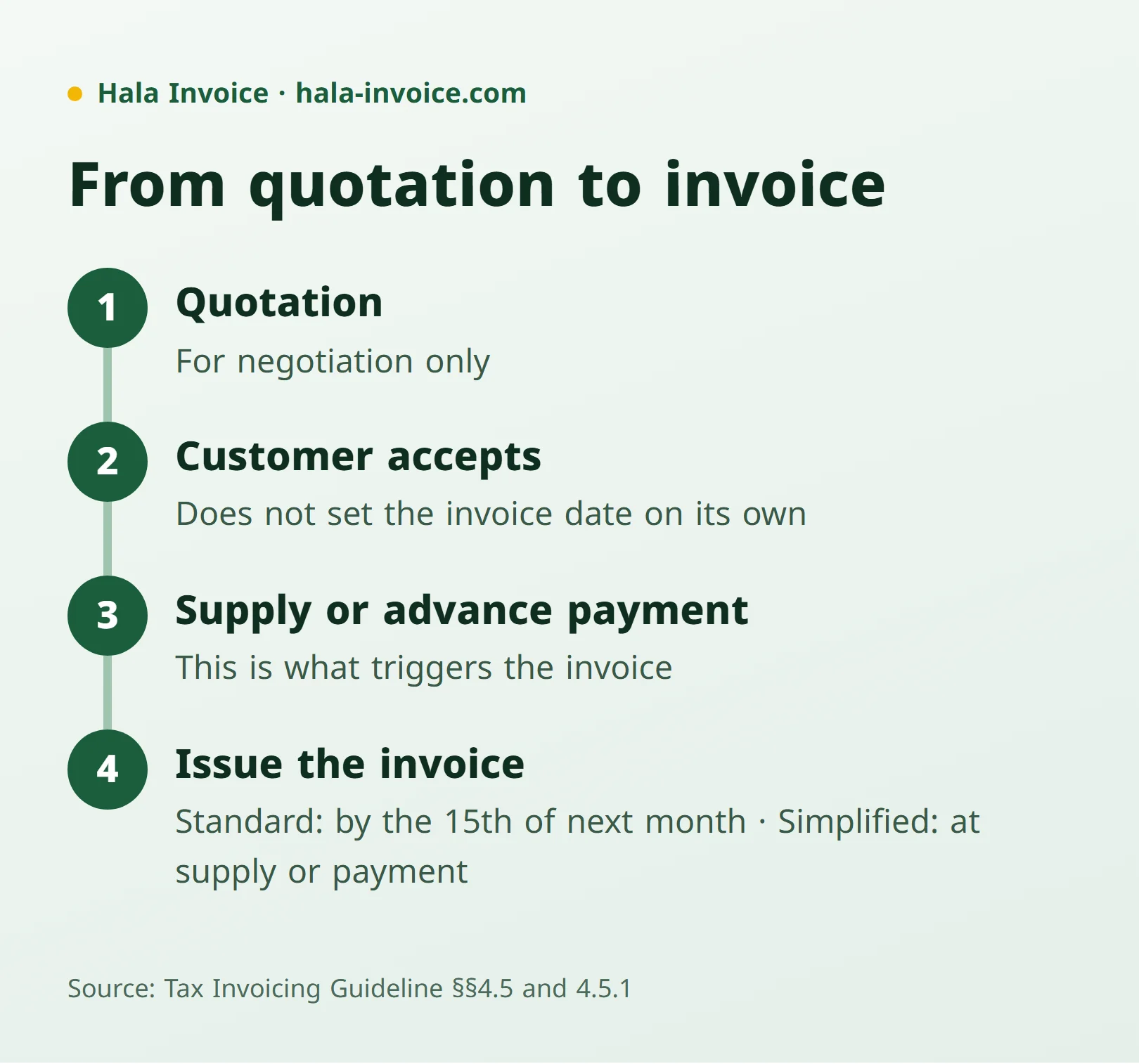
- Standard tax invoice: issue it no later than the fifteenth day of the month following the month of supply.
- Simplified tax invoice: issue it on the date of supply or receipt of full or partial payment, whichever is earlier. Financial-services supplies made by licensed banks, financial institutions, or insurance companies, and other supplies specified by decision of ZATCA's Governor, have an exception until the fifteenth day of the month following the supply month, provided the customer's name, address, and supply date are added to the usual information; see Article 53(7)(c).
- Advance payment: receipt establishes the date of supply for tax purposes to the extent of the amount received, and the relevant invoice-issuance rules apply.
For example, if a transaction requires a standard invoice and its date of supply falls in October, the issuance deadline is 15 November. This illustrates the rule; it is not a period starting when the quotation was sent. Source: invoicing guideline, sections 4.5 and 4.5.1.
How do you move from the quotation to the invoice?
Review the customer's agreed items before copying them into the invoice: has the quantity changed? Was a service added? Have you received an advance payment? Review these points so the invoice reflects the actual transaction.
Then review the required invoice information, including its issuance date, sequential number, supplier details and VAT number, description of the supply, amounts, and tax, allowing for the differences between invoice types. Use the tax-invoice issuance steps and tax-invoice template for your review. Source: invoicing guideline, sections 4.2.3 and 4.3.2.
Also take care when issuing an actual tax invoice before performing the supply. The guide explains that doing so can bring forward the tax point even if payment has not yet been received. Do not use a tax invoice merely as a differently titled quotation. Source: invoicing guideline, section 4.5.1.
Common mistakes when preparing a quotation invoice
- Heading a negotiation document “Tax Invoice” without establishing what it actually represents.
- Relying only on a quotation or receipt voucher after receiving an advance that requires an invoice.
- Applying the standard-invoice deadline to every simplified invoice.
- Copying a quantity or discount from an old quotation without reviewing the final agreement.
- Presenting the suggested quotation fields as a single statutory checklist.
The tax-related mistakes above follow from the definition and timing rules; reviewing versions and agreed items is an organizational recommendation. Source: invoicing guideline, sections 2 and 4.5.
Practical rule: use the quotation to explain your proposal, then issue the required invoice when its trigger occurs and within its deadline, linking the documents with a clear reference.
When you reach the invoice-preparation step, start with the free Hala Invoice generator.
Frequently Asked Questions
Is a quotation a tax invoice?
A quotation intended for negotiation does not replace the required tax invoice; invoice status depends on the supply and statutory information, rather than the heading alone. Source: section 2.
Do I issue an invoice if the customer pays a deposit?
If the amount is an advance towards a taxable supply, receipt triggers the tax point to that extent, and a receipt voucher alone is insufficient. Source: section 4.5.1, and e-invoicing FAQ, p14.
When should I turn a quotation into an invoice?
Link issuance to the date of supply or advance payment, and apply the deadline for the invoice type used; acceptance of the quotation alone does not replace checking those events. Source: sections 4.5 and 4.5.1.
Can I rename a quotation and send it as an invoice?
Changing the heading alone does not satisfy invoice requirements; review the information required for its type and the transaction it documents. Source: sections 4.2.3 and 4.3.2.
Keep learning
Related Saudi guides
Invoice Types
How to issue a tax invoice in Saudi Arabia
Choose a standard or simplified invoice, enter the required details, calculate VAT, and check the issue date and QR code using official ZATCA sources.
Read guideInvoice Types
Receipt voucher or tax invoice: when do you need each?
A receipt voucher records money received but does not remove a required tax invoice. Learn the difference, advance-payment rules, and how to link the documents.
Read guideVAT
VAT registration for Saudi businesses: thresholds and invoices
Mandatory registration generally starts above SAR 375,000; voluntary eligibility starts at SAR 187,500, subject to conditions. Learn what changes on invoices.
Read guideReady to Create Your Invoice?
Create a local invoice PDF with ZATCA-format QR data – free with no signup
Create Invoice Now✓ 100% Free • ✓ No Signup • ✓ ZATCA-format QR data