
Invoice without a VAT number: what an unregistered business issues
A business that is unregistered and not required to register can document a sale commercially, but cannot issue a tax invoice or collect VAT from the customer.
An invoice without a VAT number can represent different situations. If your business is unregistered and is not required to register, it does not have to issue tax invoices for its sales. The transaction can be documented commercially without presenting the document as a tax invoice or collecting VAT. A registered business, however, cannot treat the supplier's number as an optional field on its tax invoice. The distinction is the seller's actual status, rather than the appearance of the chosen template. Guideline, 4.1, 4.1.2, 4.1.3 and 4.2.3.
First establish why there is no VAT number
Use this comparison before sending the document to the customer:
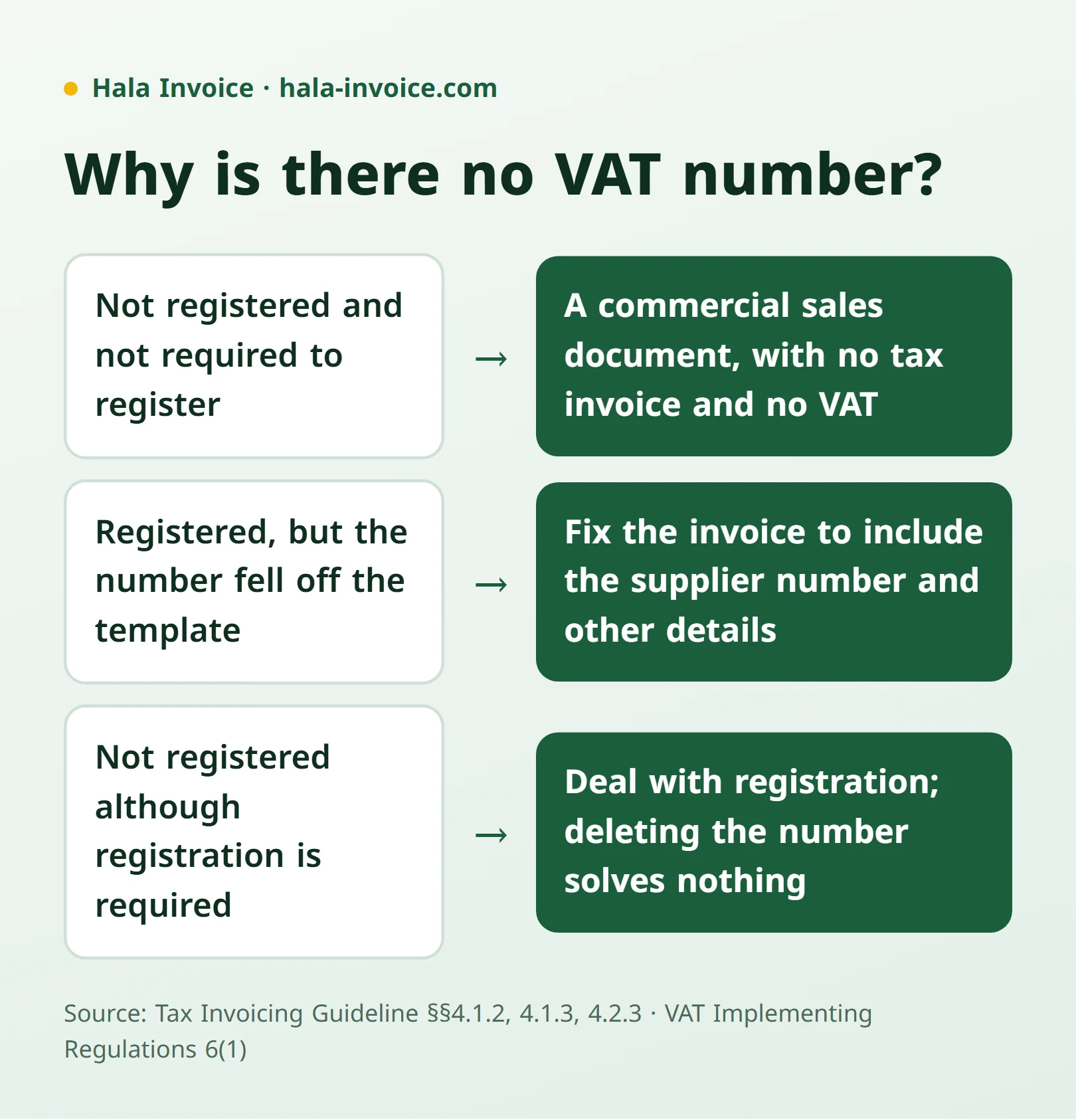
| Business's position | Appropriate action from a VAT perspective |
|---|---|
| Unregistered and not required to register | Document the sale commercially, without issuing a tax invoice or collecting VAT |
| Registered, but the number was omitted from the template | Review the invoice to include its required details, including the supplier's number |
| Unregistered despite meeting mandatory registration conditions | Address registration and the related obligations; omitting the number does not resolve the issue |
The first two situations follow the Guideline, 4.1.2, 4.1.3 and 4.2.3. The last follows the authority's power to register someone who failed to apply when required. Regulations, 6(1).
This concerns VAT requirements specifically. The guideline explains that invoice issuance and retention requirements under other laws apply alongside the tax rules. Do not therefore treat being unregistered as a general exemption from documenting transactions or meeting your activity's other requirements. Guideline, 4.1.
Why not add VAT and leave the number blank?
The guideline states that someone who is not VAT-registered cannot issue a tax invoice, and also addresses attempts to collect an amount as VAT. Do not therefore address the missing number by adding a VAT line to an invoice bearing a different commercial title. Guideline, 4.1.3.
The authority also considers the document's substance: a financial document intended to show or collect VAT is treated as a tax invoice when applying the rule on issuance by an unregistered person. Changing the title alone is therefore insufficient to correct the transaction. Guideline, Section 2.
If a customer requests a tax invoice, do not use another business's number to satisfy the request. The supplier number on the invoice is its registration number shown on its certificate, or its tax group's number if it is a member. Explain your business's status before agreeing on the document required. Guideline, 4.2.3.
What should you put on a non-tax sales document?
The following is an editorial recommendation for organizing the transaction, rather than a list of mandatory tax fields for an unregistered business:
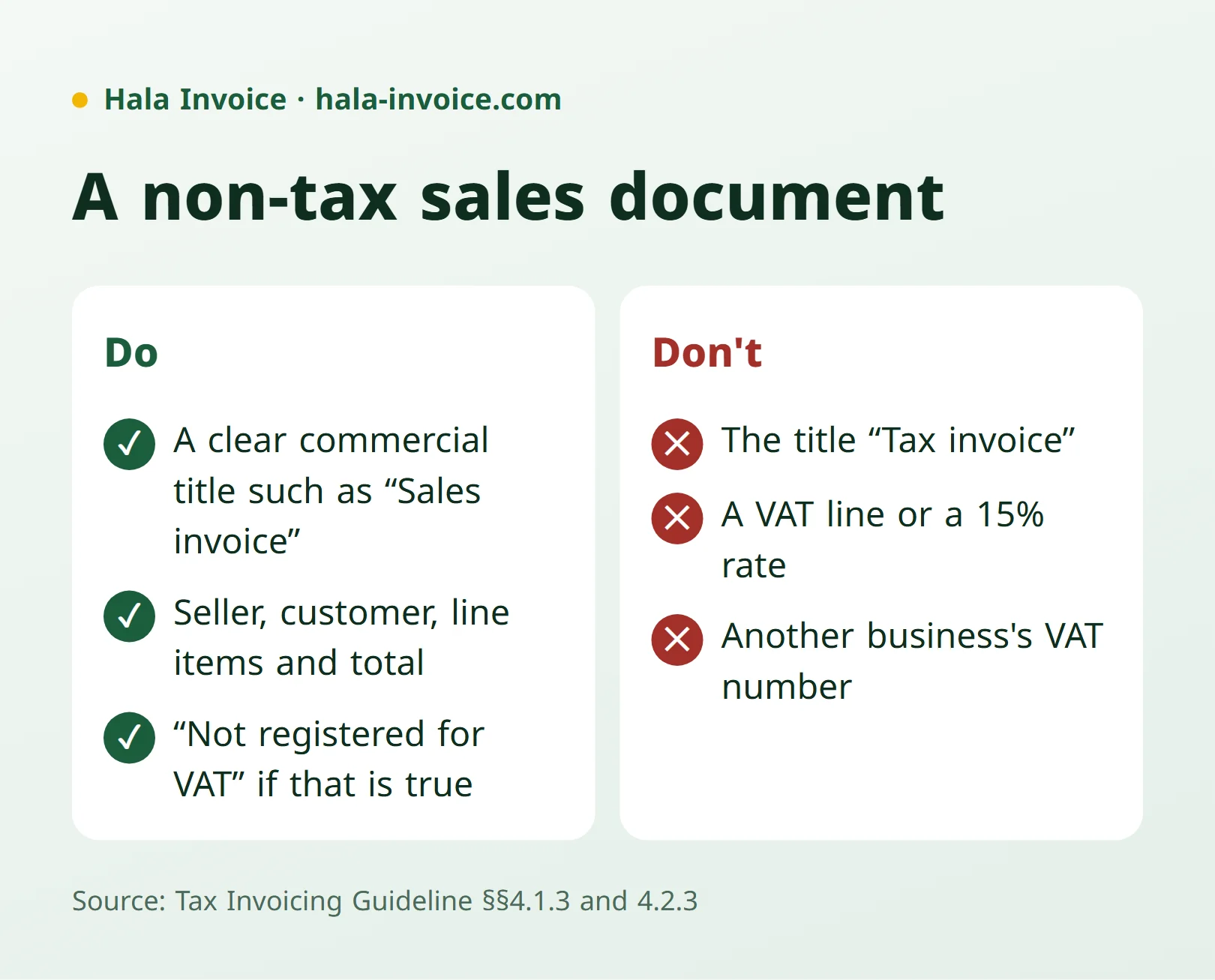
- Choose a clear title, such as “Sales invoice,” reflecting the document's commercial purpose.
- Enter the seller's name and contact details, followed by the customer information needed to manage the transaction.
- Add a reference number and date to help you locate the document and discuss it with the customer.
- Describe the goods or services, quantities, prices and agreed discounts, and show the total payable.
- Clarify the payment method, amount paid and balance where useful for the transaction.
- Add “The business is not registered for VAT” if that accurately describes your position, and do not show an amount collected as VAT.
The legal basis for separating these documents is that a supplier not required to register does not have to issue a tax invoice, while an unregistered person is prohibited from issuing one. The arrangement above is a practical suggestion that you can discuss with your accountant to suit your activity. Guideline, 4.1.2 and 4.1.3.
For more on the distinction, read sales invoices and tax invoices. We suggest reviewing the invoice title and its line items together so that tax wording from an earlier template is not left behind after other details have changed.
When do you need to move to tax invoices?
Review registration status regularly. The general rule for a resident business tests whether supplies counted for registration exceed SAR 375,000 over the preceding twelve months or are expected to exceed it over the following twelve months, subject to statutory exceptions. Being unregistered in practice does not remove a requirement to register when the conditions are met. Guideline, 3.2; Regulations, Articles 3, 4 and 6(1).
See business registration thresholds, then read the registration certificate when issued: it states your number and the effective date. Do not substitute the date the certificate reaches you for that effective date. Once your position is established, review the steps for issuing a tax invoice. Regulations, 8(5).
Common mistakes and a final review
- Naming the document “Tax invoice” when the supplier is unregistered.
- Adding VAT to the total while leaving the number field blank.
- Using another business's number instead of the actual supplier's number.
- Continuing to use documents without VAT as a substitute for addressing mandatory registration.
This review follows the Guideline, 4.1.3 and 4.2.3 and Regulations, 6(1).
Practical rule: establish the seller's position first, then choose a document that describes it accurately without collecting VAT that an unregistered person cannot collect.
Start with Hala Invoice's free invoice generator, and review the document type and details against your actual registration status before using it.
Frequently Asked Questions
Can I issue an invoice without a VAT number?
From a VAT perspective, an unregistered supplier that is not required to register does not have to issue a tax invoice, but cannot issue one or collect VAT. Use a commercial document describing the transaction. Guideline, 4.1.2 and 4.1.3.
Can I charge VAT if I am not registered?
No. The guideline prohibits an unregistered person from issuing a tax invoice or seeking to collect an amount as VAT. Guideline, 4.1.3.
A customer wants my VAT number but I do not have one. What should I do?
Explain your business's status and do not use someone else's number. The supplier number on a tax invoice relates to its own registration or its tax group. Guideline, 4.1.3 and 4.2.3.
I am registered but forgot my VAT number on an invoice. Is that okay?
The supplier's number is required on standard and simplified invoices. If the invoice has been issued, review the process for correcting its details through a note as appropriate, retaining the original unchanged. Guideline, 4.2.3, 4.3.2, 4.5 and 7.1; Regulations, 54(3).
Keep learning
Related Saudi guides
Invoice Types
How to issue a tax invoice in Saudi Arabia
Choose a standard or simplified invoice, enter the required details, calculate VAT, and check the issue date and QR code using official ZATCA sources.
Read guideInvoice Types
Quotation invoice: when do you need a tax invoice instead?
A quotation sets out a commercial proposal. Learn what to include and when a sale or advance payment requires a tax invoice instead.
Read guideInvoice Types
Receipt voucher or tax invoice: when do you need each?
A receipt voucher records money received but does not remove a required tax invoice. Learn the difference, advance-payment rules, and how to link the documents.
Read guideReady to Create Your Invoice?
Create a local invoice PDF with ZATCA-format QR data – free with no signup
Create Invoice Now✓ 100% Free • ✓ No Signup • ✓ ZATCA-format QR data