
Sales invoice or tax invoice? Choosing in Saudi Arabia
Learn when a tax invoice is required and when it is not, and why seller status, customer type and the supply determine the document you need.
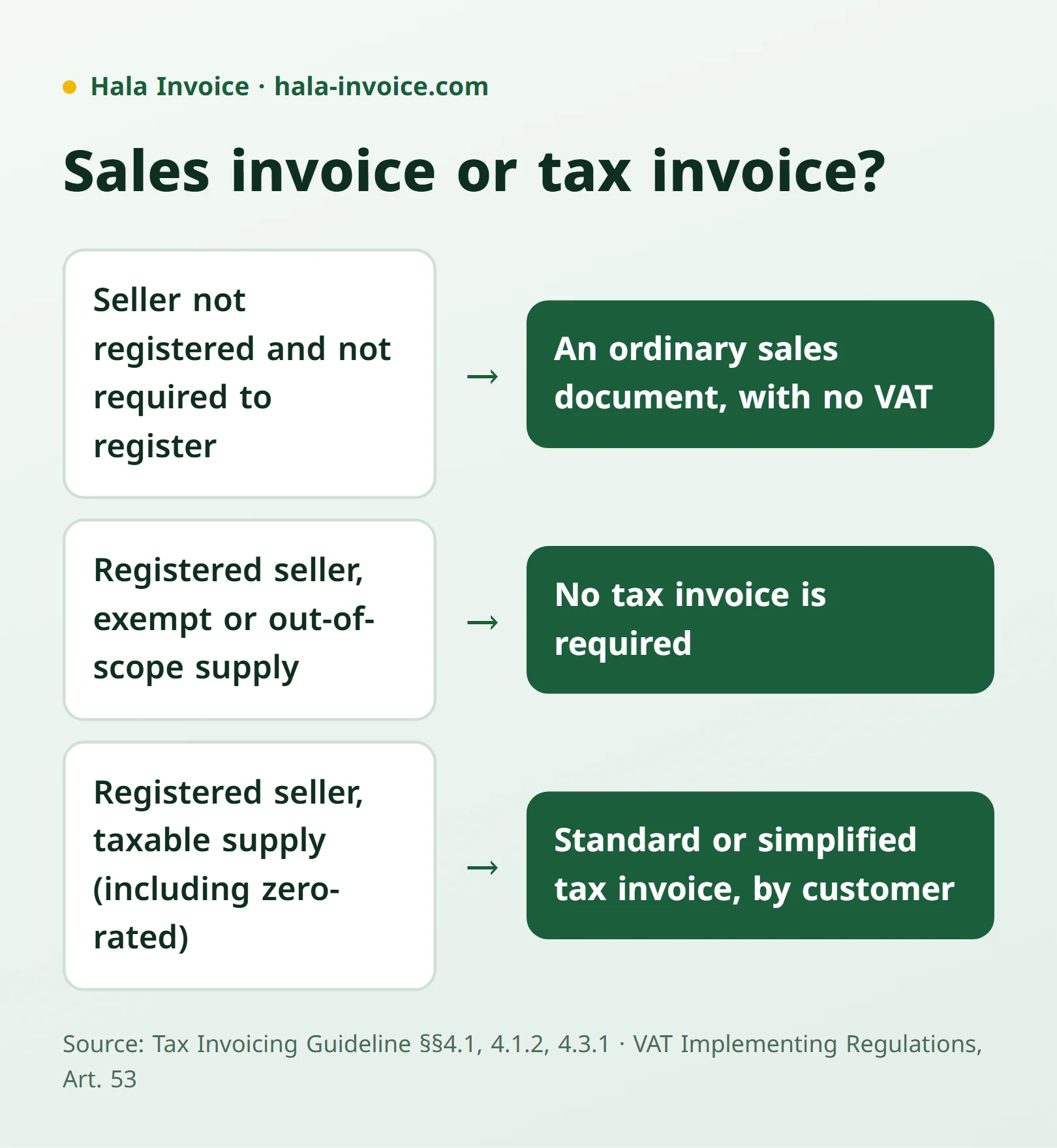
“Sales invoice” describes a sales document in commercial use, but whether a tax invoice is needed depends on the supplier's status, the supply, and the customer. If your business is neither VAT-registered nor required to register, a tax invoice is not required and you cannot collect an amount as VAT. A registered supplier must issue the required tax invoice for taxable supplies; calling the document a “sales invoice” does not remove that obligation. This distinction follows Sections 2 and 4.1 of the Tax Invoicing Guideline.
How does the commercial name differ from tax status?
ZATCA's guideline describes an invoice as a commercial document showing goods, services, quantities, and values, then specifies the details needed for a tax invoice. An invoice can therefore record a sale and serve the tax purpose at the same time. As a practical workflow, use the required tax invoice to document the sale instead of duplicating the transaction in another document simply because the names differ. What matters is that the document displays its invoice type and required details and is issued using the required method. See Sections 4.2 and 4.2.3.
As a practical starting point, ask “What kind of transaction is this?” before looking for a template. An attractive logo or the word “sales” does not establish registration status or tax treatment. Likewise, choosing the title “Tax Invoice” does not entitle an unregistered business to issue one.
When is a tax invoice not required?
For VAT purposes, Section 4.1.2 of the Tax Invoicing Guideline identifies cases where a tax invoice is not required, including:
- Goods or services supplied by someone who is neither required to register nor VAT-registered.
- Domestic supplies exempt from VAT.
- Transactions entirely outside the scope of VAT in Saudi Arabia.
In these cases, organise the sales document according to the transaction and any other requirements relevant to your activity. This is a workflow suggestion, not a universal list of VAT-law fields for every ordinary invoice. Section 4.1 points out that requirements under other legislation continue to apply.
Do not place a business that meets the registration conditions in the first category just because it has not completed its application. Being unregistered in practice does not remove the registration obligation. Read our VAT registration thresholds guide before choosing this route, and our guide to invoices without a VAT number for details of a non-tax document.
When is a tax invoice required?
For a taxable supply by a registered supplier, identify the customer type and then check the exceptions. The following table covers ordinary domestic transactions, based on Article 53(1) and 53(7) and Section 4.3.1 of the Tax Invoicing Guideline.
| Customer or transaction | Choice |
|---|---|
| A business or another entity specified in Article 53(1) | A standard invoice; a simplified invoice may be used when the supply value is below SAR 1,000 |
| A consumer acting as a non-taxable natural person | A simplified invoice regardless of supply value |
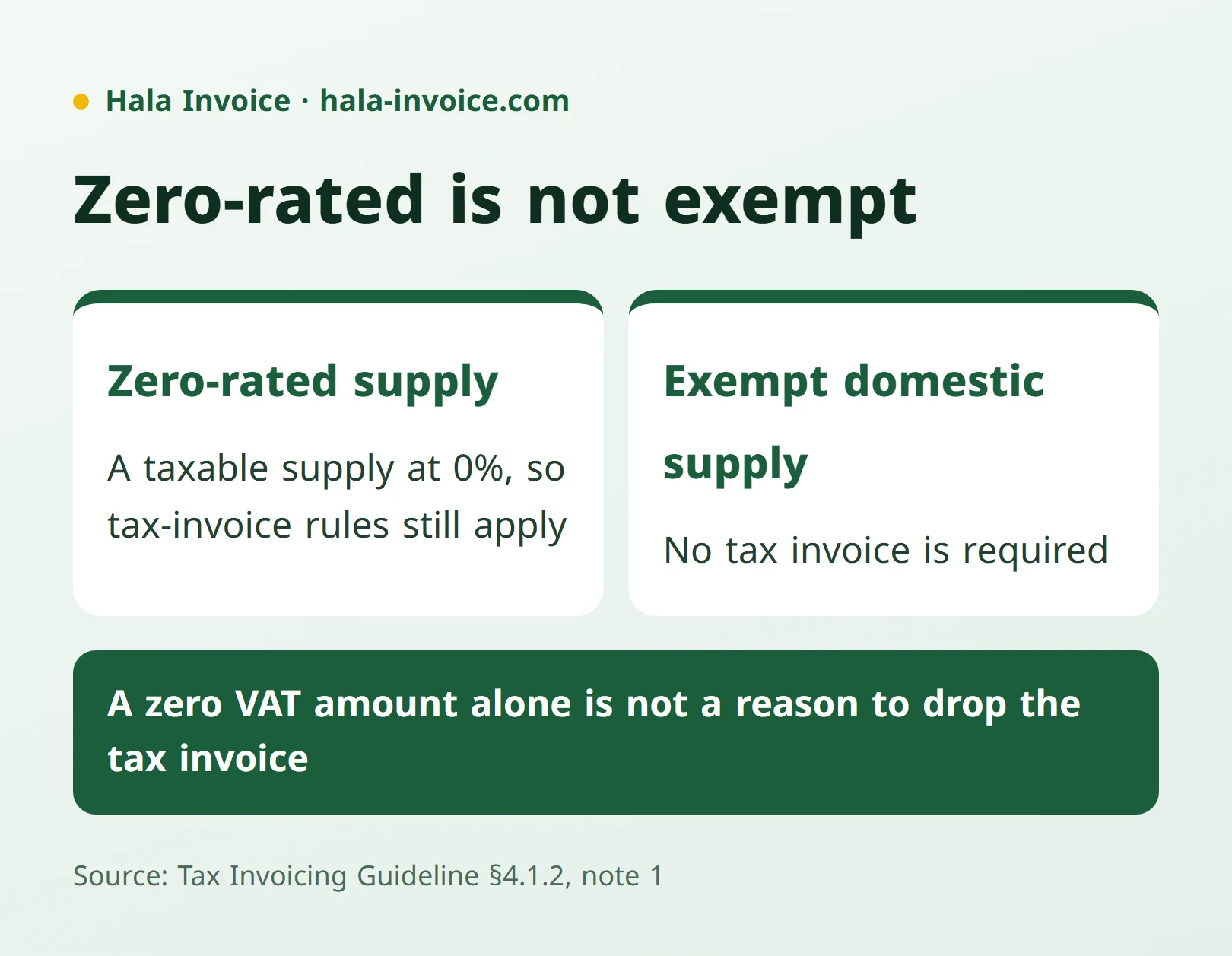
| A domestic zero-rated supply | It remains a taxable supply; the appropriate invoice depends on the conditions of the case |
The final row matters: zero-rating differs from exemption. Section 4.1.2, note 1 explains that zero-rated supplies remain taxable supplies. A zero VAT amount alone is therefore not a reason to omit a tax invoice.
Check the details and amounts before delivering the document
For a tax invoice, check the supplier's details and VAT number, invoice number and date, goods or services description, amounts, and tax information. A standard invoice needs customer details and additional information, while a simplified invoice has a different minimum. Sections 4.2.3 and 4.3.2 explain the fields. Follow our invoice issuing steps for a detailed walkthrough.
The 15% rate applies to a standard-rated supply, under Section 1.3. Establish the correct treatment first, then calculate the amount. Do not let a template setting determine whether the transaction is taxable or exempt. If you are unregistered, do not add VAT or borrow a VAT number to complete the fields.
Separate invoice issuing from payment tracking
Do not wait for the full sales amount to be collected before checking your invoicing duty. Article 53 addresses supplies and advance payments: a standard invoice is issued no later than the fifteenth day of the month following the supply month. A simplified invoice is issued at supply or receipt of full or partial consideration, whichever comes first, subject to specified exceptions. See Article 53(1)(b) and 53(7)(b)–(c) and Section 4.5.
As a practical workflow, keep the invoice reference in your payment records. Use our receipt voucher and invoice guide to distinguish their purposes. Electronic issuing and document-retention requirements continue to apply to those within their scope, as explained in Sections 4.2, 6.3, and 8.1.
Common mistakes when choosing a sales invoice
- Treating the word “sales” as a reason to omit a required tax invoice.
- Assuming every invoice without VAT concerns an exempt supply.
- Collecting VAT before registration, or using a VAT number that does not belong to the supplier.
- Choosing a simplified invoice solely because the business is small, without considering the customer and transaction.
- Confusing the payment collection date with the invoice issue deadline.
Practical rule: Choose the invoice type from the supplier's status, the customer, and the supply, then ensure the document title and details reflect that choice.
After identifying the appropriate document, organise its details with the free Hala Invoice generator.
Frequently Asked Questions
Is a sales invoice the same as a tax invoice?
A sales invoice can be a tax invoice if it concerns a taxable supply and meets the relevant requirements; the commercial name alone is insufficient. See Sections 2 and 4.2 of the Tax Invoicing Guideline.
Can I issue a sales invoice without VAT?
If you are neither registered nor required to register, do not issue a tax invoice or collect VAT; organise an ordinary sales document. A registered supplier determines the treatment from the supply, under Sections 4.1.2 and 4.1.3.
Does an unregistered customer need a tax invoice?
Yes. The customer's lack of registration does not remove a registered supplier's obligation for a taxable supply. Section 4.3.1 distinguishes a consumer acting personally from a business customer when choosing the type.
Does a credit sale need a tax invoice?
Deferred payment does not remove the obligation to issue an invoice for a taxable supply on time. See the issuing and supply-date rules in Sections 4.5 and 4.5.1.
Keep learning
Related Saudi guides
Invoice Types
How to issue a tax invoice in Saudi Arabia
Choose a standard or simplified invoice, enter the required details, calculate VAT, and check the issue date and QR code using official ZATCA sources.
Read guideInvoice Types
Quotation invoice: when do you need a tax invoice instead?
A quotation sets out a commercial proposal. Learn what to include and when a sale or advance payment requires a tax invoice instead.
Read guideInvoice Types
Receipt voucher or tax invoice: when do you need each?
A receipt voucher records money received but does not remove a required tax invoice. Learn the difference, advance-payment rules, and how to link the documents.
Read guideReady to Create Your Invoice?
Create a local invoice PDF with ZATCA-format QR data – free with no signup
Create Invoice Now✓ 100% Free • ✓ No Signup • ✓ ZATCA-format QR data